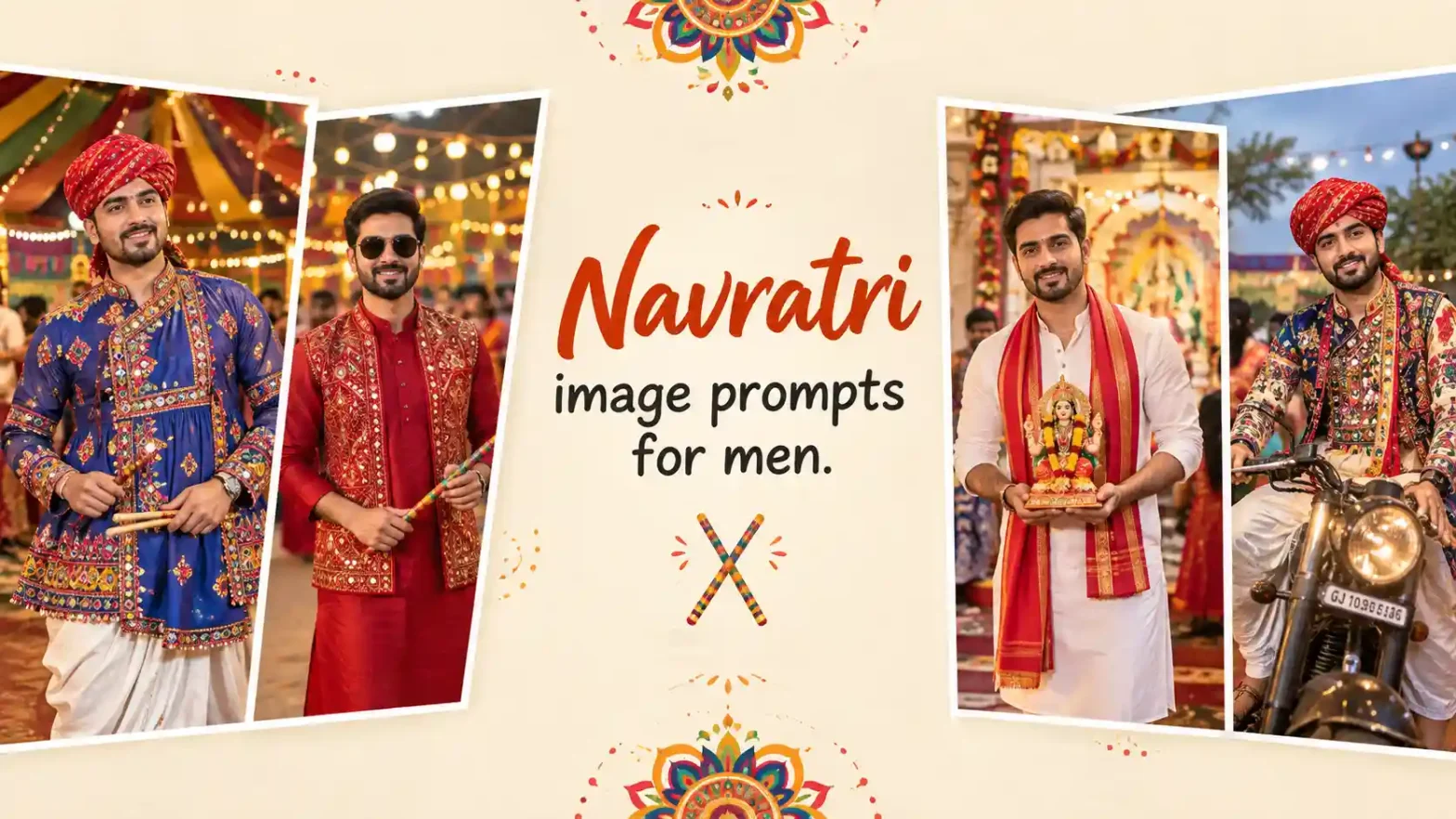
Navratri is the perfect time to dress up, attend garba nights, play dandiya, and enjoy the festive atmosphere with friends and family.
 Get on WhatsApp
New image & Video workflow everyday
Get on WhatsApp
New image & Video workflow everyday
And of course, you will want some good photos too.
With Navratri image prompts for men, you can upload your own photo and turn it into a festive Navratri portrait. Try a traditional kediyu, a stylish kurta, a Gujarati garba look, or even a modern Indo-western outfit.
Here are 10+ ready-to-use prompts with different Navratri outfit ideas for men. Copy a prompt, upload your photo, and create your own Navratri look.
What are Navratri Image Prompts for Men?
Navratri image prompts are text instructions that tell an AI how you want your photo to look.
For example, you can ask AI to dress you in a traditional Navratri dress for men, change the background to a garba ground, add dandiya sticks, or create a colorful Navratri photoshoot.
A detailed prompt can describe your clothes, pose, background, lighting, accessories, and photography style. When using your own photo, you can also ask the AI to keep your original face and recognizable features.
Navratri image prompts for men
Here, you’ll find prompts that you can simply copy and paste into any AI tool like ChatGPT, Gemini, or LightX.
1. Traditional Gujarati Garba Look
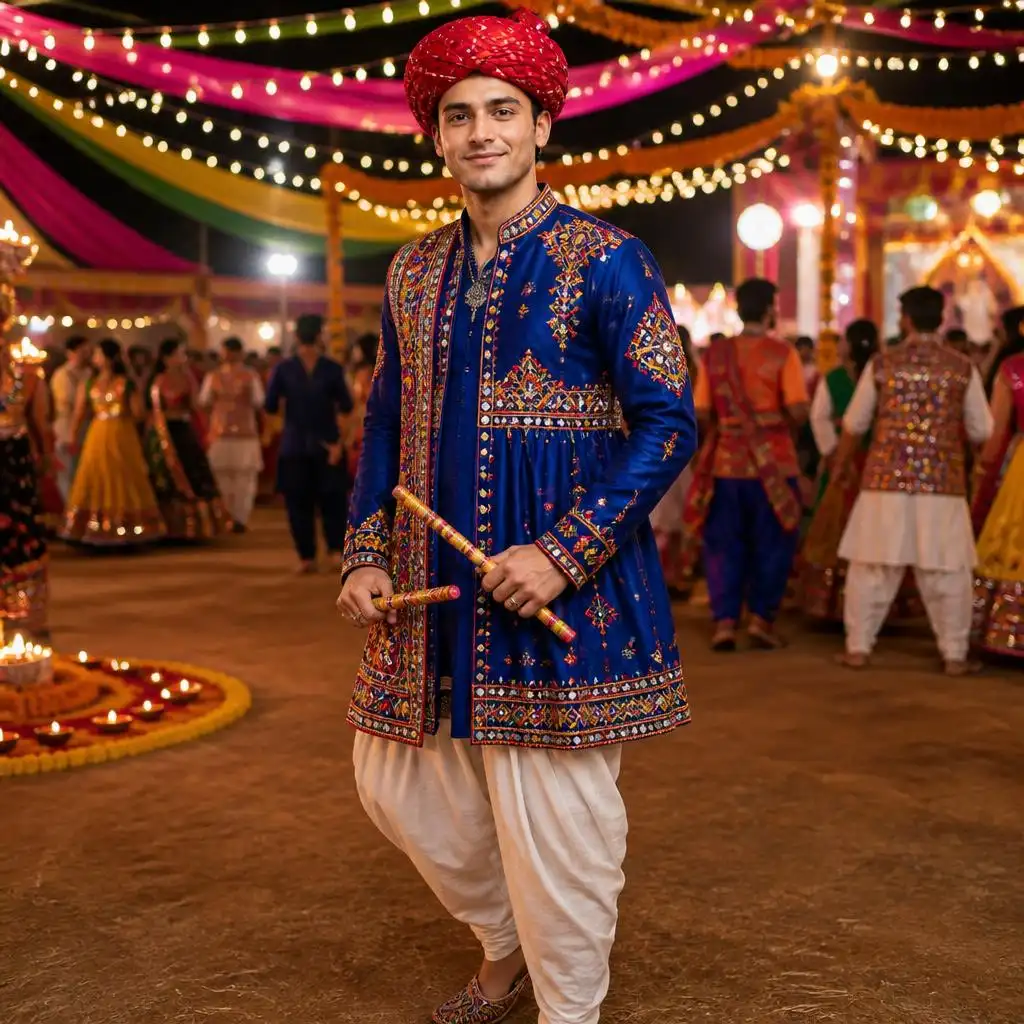
Transform the uploaded photo into a hyper-realistic Navratri AI photo for men while preserving the man’s exact face, facial structure, skin tone, hairstyle, beard, age, and identity from the reference image. Dress him in an authentic traditional Gujarati kediyu in deep royal blue, covered with detailed multicolour Kutch embroidery, tiny mirror work, thread patterns, and handcrafted borders. Pair it with an off-white dhoti-style bottom, embroidered mojari shoes, a red Bandhani pagdi, and subtle traditional silver accessories. Place him standing confidently at a grand outdoor Garba ground in Gujarat during Navratri night. Hundreds of warm fairy lights hang overhead while colourful fabric canopies, marigold decorations, clay diyas, and blurred Garba dancers fill the background. He holds two decorated wooden dandiya sticks naturally at waist level. Capture this like a professional Navratri fashion photoshoot using a full-frame camera, 85mm lens, shallow depth of field, sharp facial details, realistic skin texture, rich festive colours, warm cinematic lighting, natural shadows, soft background bokeh, and premium Instagram editorial quality. Keep his face completely recognizable and unchanged.
2. Festive Navratri Dandiya Look
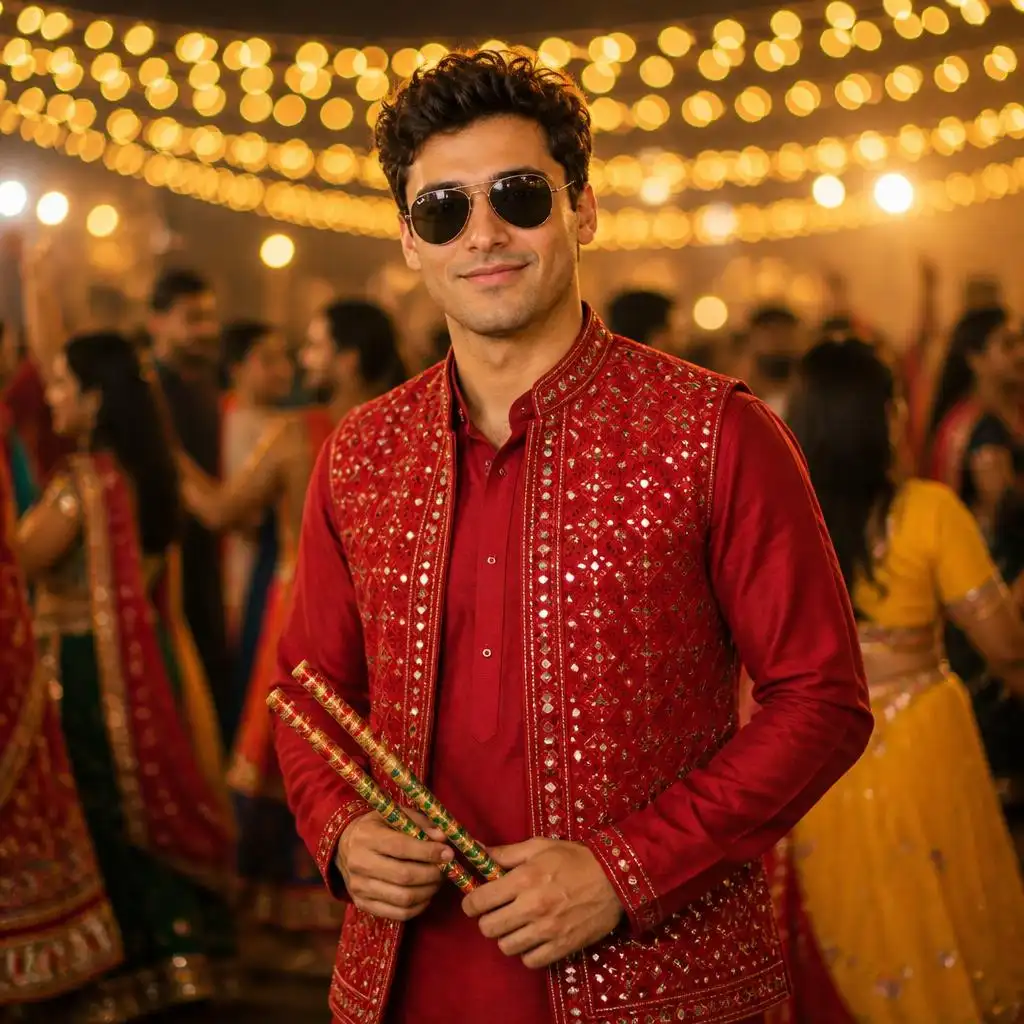
Transform the uploaded photo of the man into the same visual look and composition as the reference image. Preserve the uploaded man’s exact identity and make his face clearly recognizable. Keep his exact facial structure, skin tone, hairstyle, beard, moustache, jawline, eyes, nose, lips, age, and natural smile. Do not reshape, beautify, or replace his face. Create a mid-length portrait from around the knees/thighs upward, with the man standing slightly turned toward the camera and smiling naturally. Add stylish black aviator sunglasses with dark lenses. Dress him in a plain deep-red kurta layered with a fitted red Gujarati festive jacket covered in intricate gold embroidery, geometric threadwork, small mirror details, and traditional decorative borders. Keep the jacket shape, styling, and overall red-on-red appearance close to the reference. He holds exactly two colourful decorated dandiya sticks naturally together in front of his waist using both hands. Place him at a lively outdoor Navratri Garba night. Show blurred people dancing behind him in colourful yellow, green, red, and orange traditional outfits. Fill the upper background with multiple rows of warm golden string lights and large circular golden bokeh. Keep the background heavily blurred so the man remains the clear focus. Match the reference image closely: eye-level camera, centered subject, vertical composition, mid-length framing, warm golden-orange colour tone, soft festive lighting, shallow depth of field, 85mm portrait photography, sharp face and clothing, realistic skin and hands, creamy bokeh, natural DSLR quality. Do not change the overall pose, framing, outfit colour combination, sunglasses style, lighting mood, or festive background look.
3. Mata Rani Temple Navratri Look
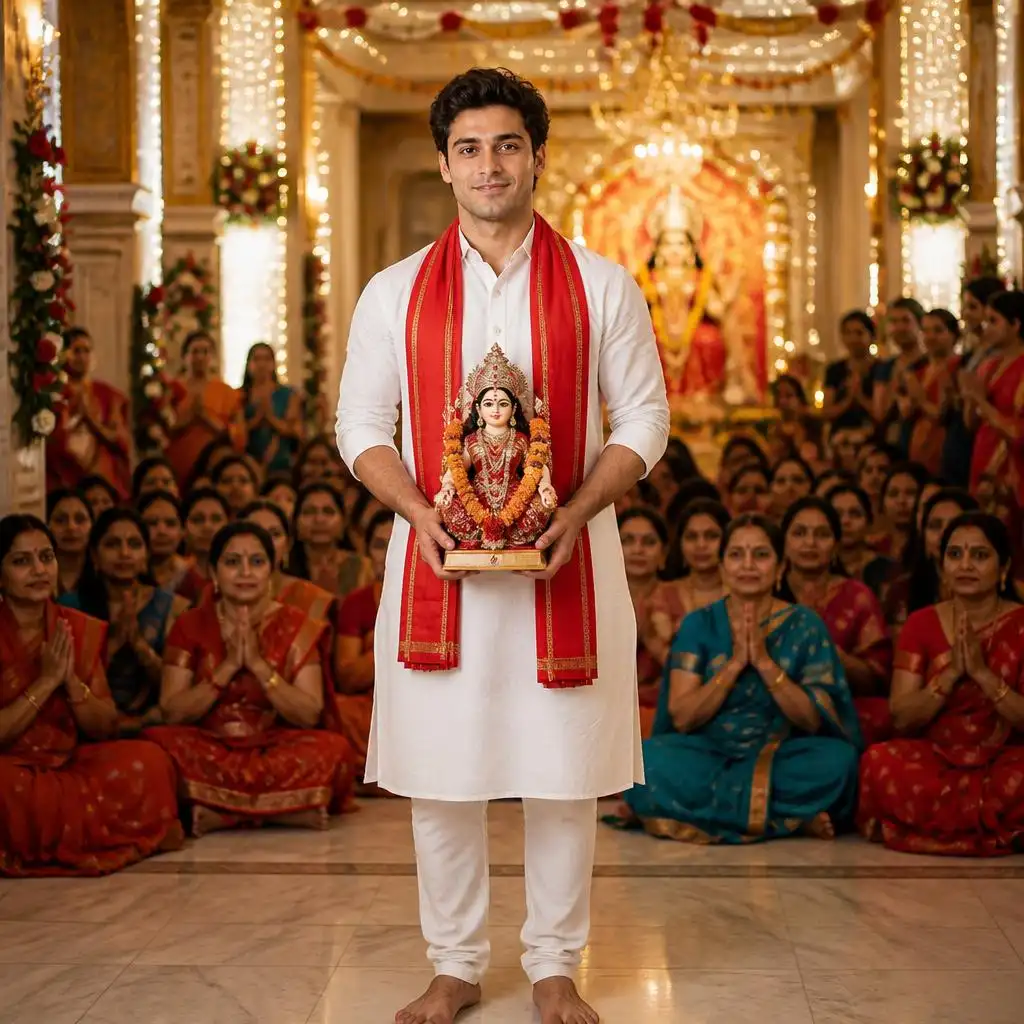
Transform the uploaded photo of the man into the same composition and visual style as the reference image, while preserving his exact identity. Keep his face clearly recognizable with the same facial structure, skin tone, hairstyle, beard or moustache, eyes, nose, lips, jawline, age, and natural expression. Do not beautify, reshape, or replace his face. Create a full-length vertical portrait inside a beautifully decorated Hindu temple during Navratri. Dress him in a simple, elegant white kurta pajama with sleeves slightly rolled up and a long red devotional stole with thin gold borders draped around his neck. He stands centered, facing the camera with a gentle natural smile. Show him respectfully holding a small, richly decorated Mata Rani idol with both hands at waist level. The idol has a golden crown, red traditional attire, marigold garlands, and detailed festive ornaments. Keep his hands and grip natural and anatomically correct. Behind him, show a large gathering of women seated and standing in colourful red, blue, teal, orange, and pink sarees, many with hands joined in prayer. In the distant center, include a softly blurred illuminated Mata Rani shrine. Decorate the temple with red and white flower arrangements, marigold garlands, ornate pillars, chandeliers, and curved rows of warm golden fairy lights. Match the reference closely: centered symmetrical framing, full-length composition, eye-level camera, white-and-red outfit, idol held at the center, devotional crowd behind him, warm temple lighting, shallow depth of field, golden bokeh, realistic skin, sharp subject details, natural DSLR photography, cinematic festive atmosphere, and photorealistic quality.
4. Navratri Bike Look
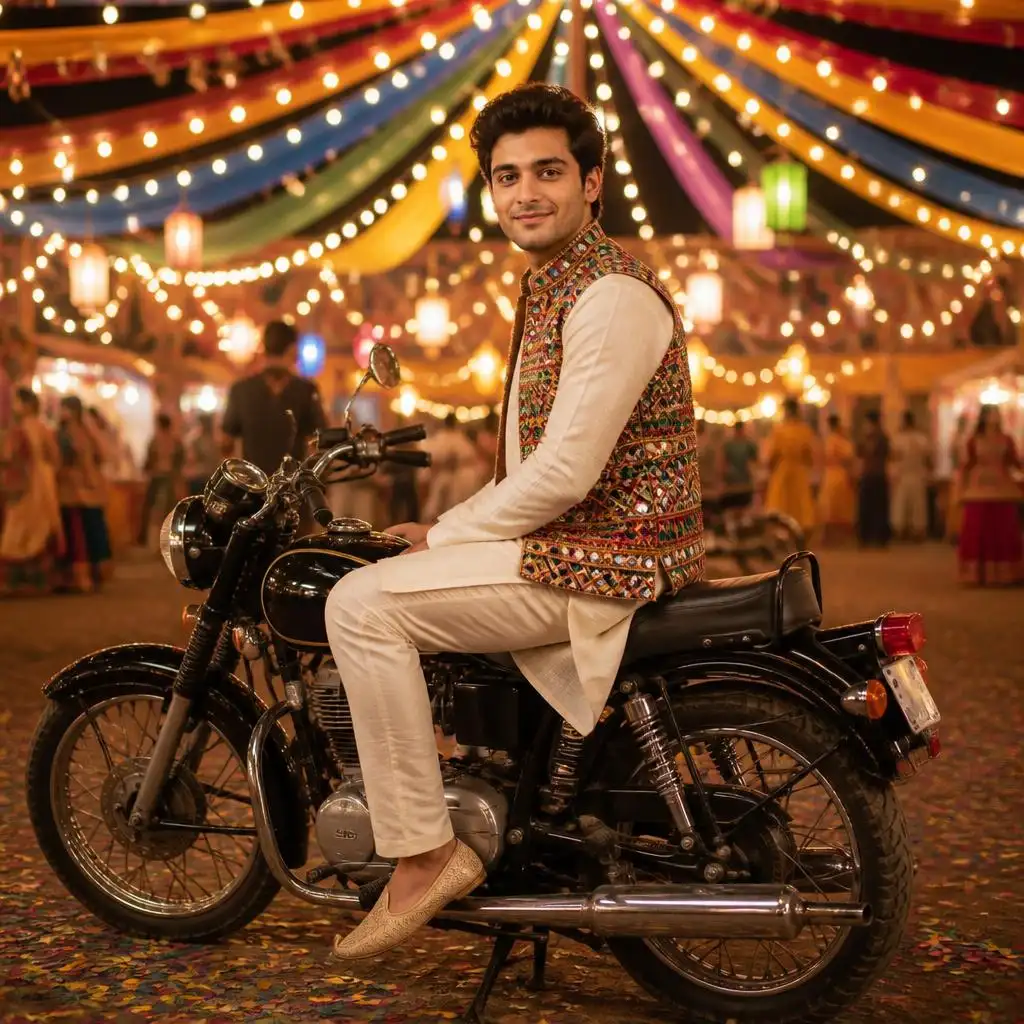
Transform the uploaded photo of the man into the same composition, pose, and festive look as the reference image, while preserving his exact identity. Keep his face highly recognizable with the same facial structure, skin tone, hairstyle, beard or moustache, eyes, nose, lips, jawline, and age. Do not beautify or reshape his face.
Create a full-body vertical portrait of him sitting naturally sideways on a classic black vintage motorcycle at a Navratri celebration. His body faces sideways while his upper body and head turn naturally back toward the camera. Give him a subtle confident smile. His hands, legs, hips, and body weight must interact naturally with the motorcycle.
Dress him in a clean off-white kurta pajama with a sleeveless multicoloured Gujarati Kutch embroidered jacket featuring detailed geometric patterns and subtle mirror work. Add traditional beige mojari shoes.
Recreate the festive background closely. Above him, large strips of red, yellow, green, blue, orange, and purple fabric radiate outward from one central point, creating a colourful canopy. Add rows of warm hanging bulbs, fairy lights, traditional lanterns, and subtle festive confetti. Keep the distant people and venue softly blurred.
Use eye-level photography, full-body framing, slightly rear three-quarter motorcycle angle, 50mm lens, shallow depth of field, warm golden lighting, creamy bokeh, realistic skin and fabric textures, and natural shadows.
The man must look physically present in the original scene, not pasted, composited, or cut out. Match the background light direction, exposure, colour temperature, shadows, depth of field, edge softness, and ambient light on his skin and clothes. Add natural contact shadows where his body touches the motorcycle. No halo, hard cutout edges, mismatched sharpness, or artificial background separation.
5. Navratri Durga Puja Look
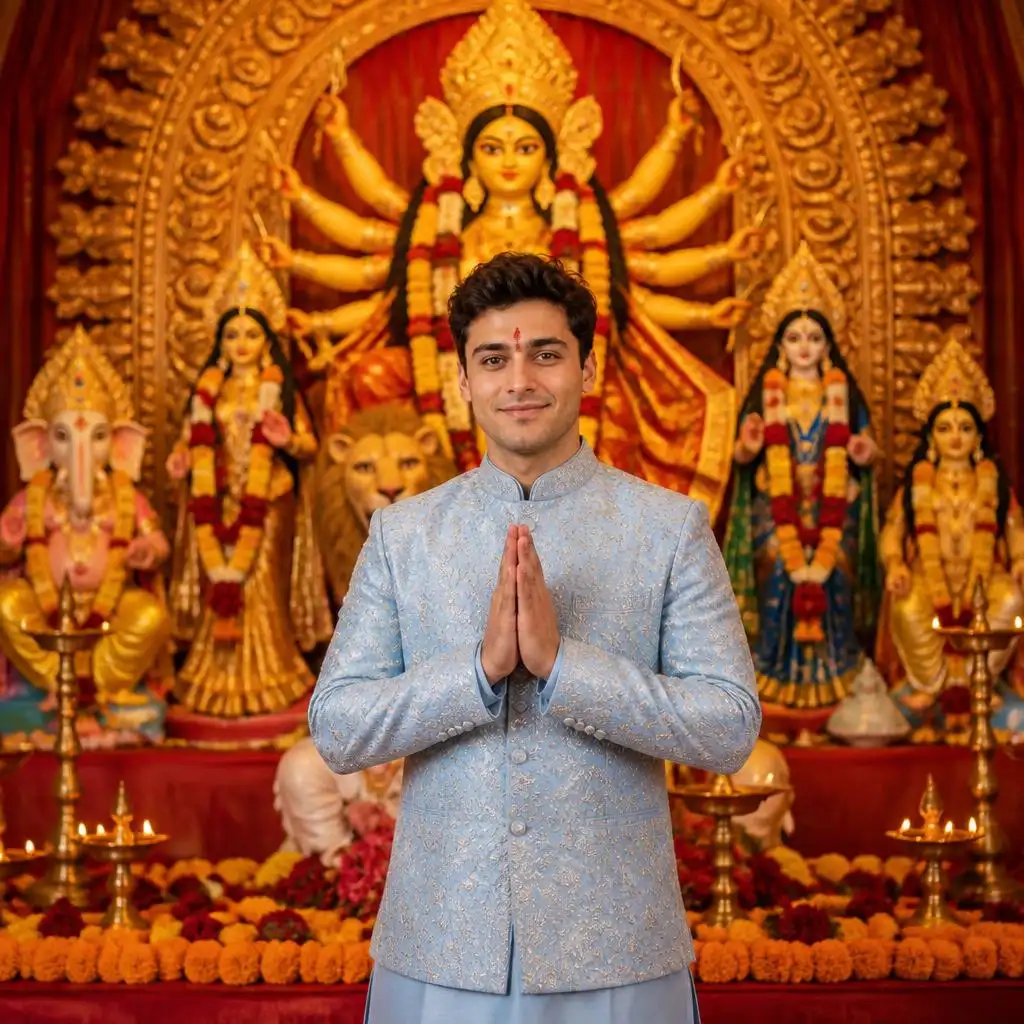
Transform the uploaded photo of the man into the same composition, pose, framing, outfit style, and devotional atmosphere as the reference image. Preserve his exact identity. Keep his original facial structure, skin tone, eyes, nose, lips, jawline, hairstyle, beard or moustache, age, and natural features clearly recognizable. Do not beautify, reshape, or replace his face.
Create a vertical mid-to-full-length portrait, framed from around the knees upward. Position him centered directly in front of a grand Maa Durga idol during Navratri/Durga Puja. He faces the camera with a calm, serious devotional expression and holds both hands naturally together at chest level in a namaste pose. Add a small traditional red tilak on his forehead.
Dress him in an elegant powder-blue traditional sherwani with a high band collar, matching buttons, subtle silver floral embroidery, and realistic premium fabric texture, paired with matching traditional bottoms.
Behind him, show a large ornate Maa Durga idol wearing a red-and-gold saree, golden crown, flower garlands, and traditional ornaments, surrounded by accompanying idols and an intricately carved golden pandal arch. Decorate the foreground with dense orange marigold garlands and red and yellow flowers. Add warm diyas and subtle festive lights.
Match the reference with centered symmetrical composition, eye-level camera, 50mm portrait lens, shallow depth of field, sharp man, slightly softer idol background, warm golden temple lighting, realistic skin, natural shadows, and DSLR quality.
The man must look naturally photographed inside the pandal, not pasted or cut out. Match the ambient light, exposure, colour temperature, edge softness, depth of field, and shadows across his face and clothing. No halo, sharp cutout edges, mismatched lighting, fake blur, or artificial compositing.
6. Navratri Garba Night Look
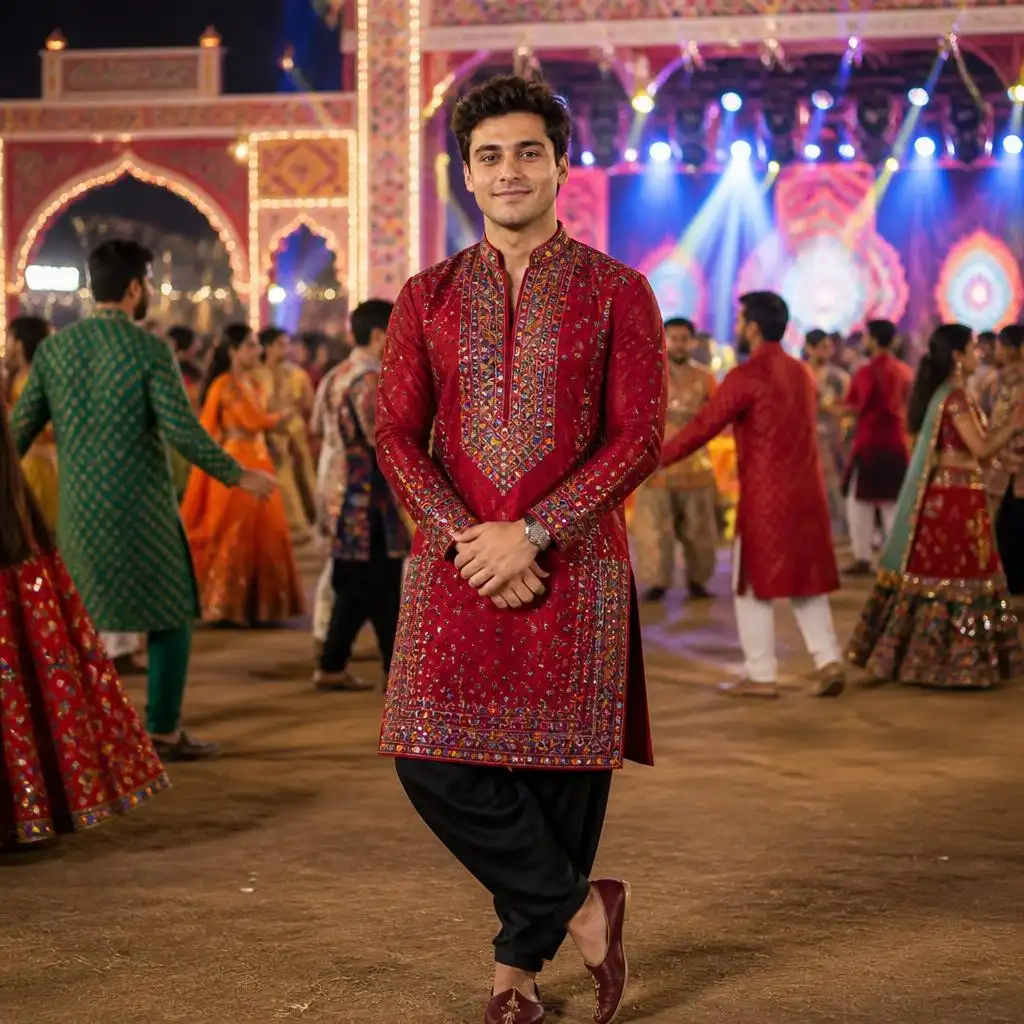
Transform the uploaded photo of the man into the same composition, pose, outfit style, and festive atmosphere as the reference image. Preserve his exact identity and make him clearly recognizable. Keep his original facial structure, skin tone, eyes, nose, lips, jawline, hairstyle, beard or moustache, age, and body proportions. Do not beautify, reshape, or replace his face.
Create a vertical full-body fashion portrait at a vibrant Navratri Garba night. Position him in the center, standing confidently with his body slightly angled toward the camera. Keep one leg naturally crossed slightly in front of the other. His hands rest naturally together near his waist. Give him a calm, confident expression while looking directly at the camera.
Dress him in a rich red traditional Gujarati kurta with dense multicoloured Ajrakh-inspired geometric embroidery and mirror-work details, paired with loose black dhoti-style pants and dark red traditional mojari. Add a simple metallic wristwatch.
Behind him, recreate a colourful Garba venue with large decorated geometric archways, a festive stage, blue and yellow spotlights, warm fairy lights, and subtle floating festive particles. Show men and women dancing in colourful green, orange, red, and gold traditional outfits, but keep them naturally blurred.
Match the reference closely with full-body framing, eye-level camera, 50mm lens, shallow depth of field, sharp subject, creamy background bokeh, warm golden foreground light, colourful blue and yellow stage lighting, realistic skin and fabric textures, natural shadows, and DSLR photography.
The man must look naturally photographed at the actual Garba venue, not pasted or cut out. Match the background light direction, exposure, colour temperature, ambient light, edge softness, shadows, and depth of field on his entire body. No halo, hard edges, mismatched sharpness, fake background blur, or artificial compositing.
7. Traditional Navratri Yellow Kurta Look
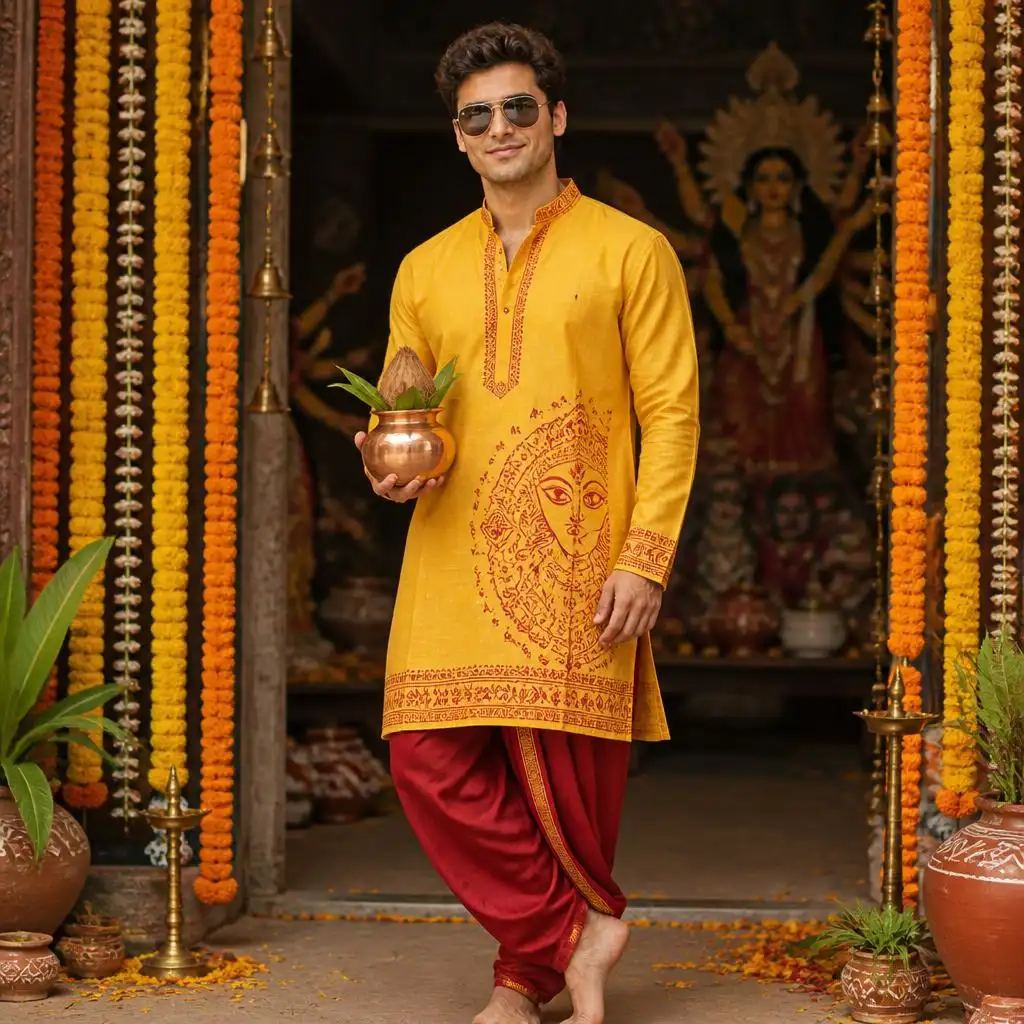
Transform the uploaded photo of the man into the same composition, pose, clothing style, and Navratri setting as the reference image. Preserve his exact identity and keep him clearly recognizable. Maintain his original facial structure, skin tone, eyes, nose, lips, jawline, hairstyle, beard or moustache, age, and body proportions. Do not beautify, reshape, or replace his face.
Create a vertical full-body portrait of him standing naturally at the entrance of a traditional Navratri pandal. His body is slightly angled toward the camera with one leg relaxed and slightly crossed. He looks directly at the camera with a calm, confident expression. Add dark aviator sunglasses with reflective blue-grey lenses.
Dress him in a bright mustard-yellow Bengali-style kurta with bold red traditional folk motifs, red embroidered borders, and a large artistic red pattern across the front. Pair it with loose deep-red dhoti-style pants. Keep him barefoot. In one hand, he naturally holds a small traditional copper kalash containing water, green mango leaves, and a coconut.
Decorate the entrance with long vertical strings of orange and yellow marigold flowers, traditional festive ornaments, brass decorative elements, scattered flower petals, and earthen pots with green leaves. Keep an unfinished Durga idol workshop or festive idol preparation area softly visible inside the background.
Use eye-level full-body framing, 50mm photography, natural daylight, sharp facial and clothing details, realistic skin, subtle background blur, authentic colours, and natural shadows.
The man must look physically present in the scene, not pasted or cut out. Match ambient light, exposure, colour temperature, edge softness, perspective, ground contact shadows, and depth of field. No halo, hard cutout edges, mismatched lighting, fake blur, or artificial compositing.
8. Mata Rani Idol Artist Look
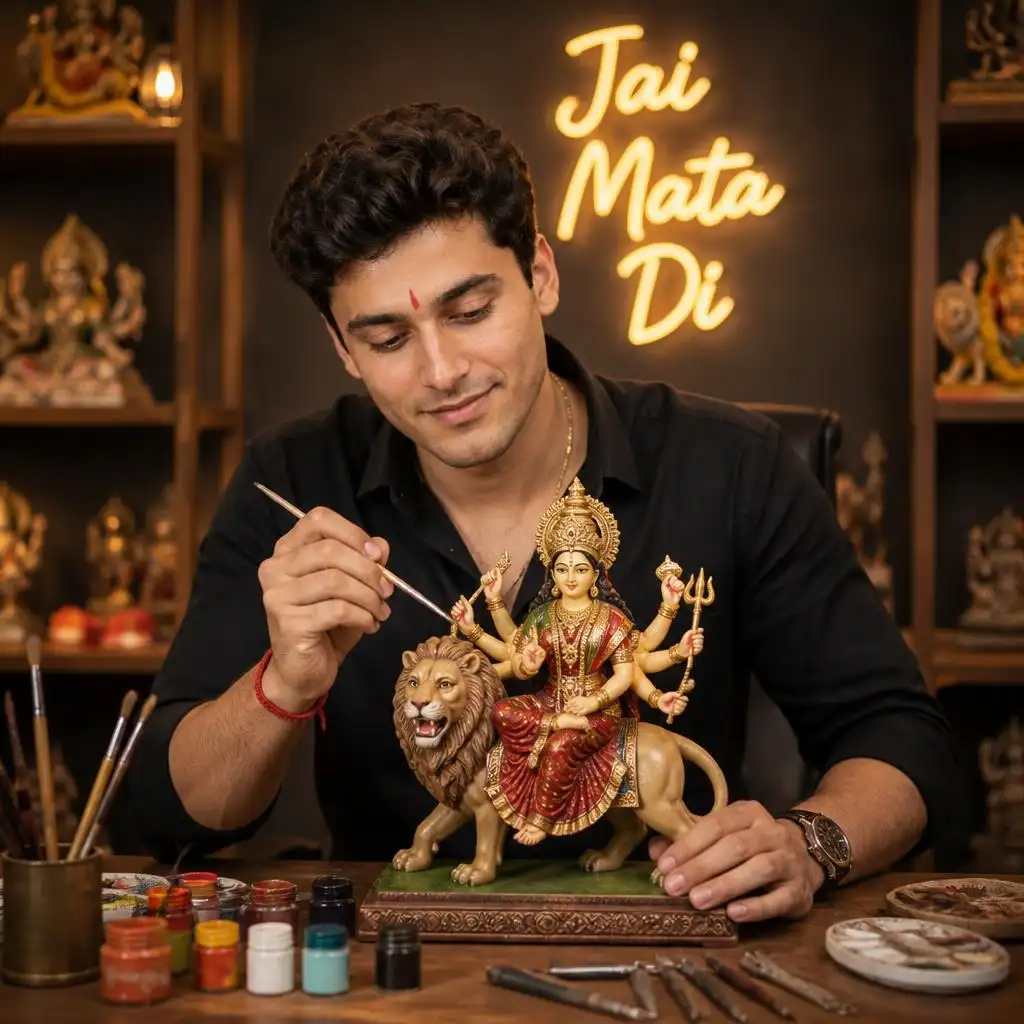
Transform the uploaded photo of the man into the same composition, pose, outfit, and devotional setting as the reference image. Preserve his exact identity and make his face clearly recognizable. Keep his original facial structure, skin tone, hairstyle, beard or moustache, eyes, nose, lips, jawline, and age. Do not beautify, reshape, or replace his face.
Create a vertical mid-length seated portrait, framed from around the waist upward. Show him sitting naturally in a black chair behind a wooden artist’s table, leaning slightly forward and looking down with a focused expression. Add a small red tilak on his forehead.
Dress him in a simple black button-up shirt with the top buttons slightly open. Add a subtle gold chain, wristwatch, and red sacred thread bracelet.
Place a detailed handmade Mata Rani idol riding a lion directly on the table in front of him. Show him carefully painting the idol using a thin paintbrush in one hand while the other hand gently steadies the sculpture. Include small paint containers, brushes, and miniature sculpting tools naturally scattered across the table.
Create a warm indoor artisan studio. Add shelves on both sides displaying small traditional deity figurines. On the dark wall behind him, include softly glowing warm-yellow text reading “Jai Mata Di”. Use warm golden ambient lighting, shallow depth of field, soft background bokeh, realistic skin and hands, detailed idol textures, and DSLR portrait quality.
The man must look naturally photographed in the room, not pasted or cut out. Match the lighting, shadows, colour temperature, perspective, sharpness, edge softness, and depth of field across his face, body, table, and background. No halo, hard cutout edges, mismatched lighting, fake blur, or artificial compositing.
9. Devotional Maa Durga Shadow Portrait
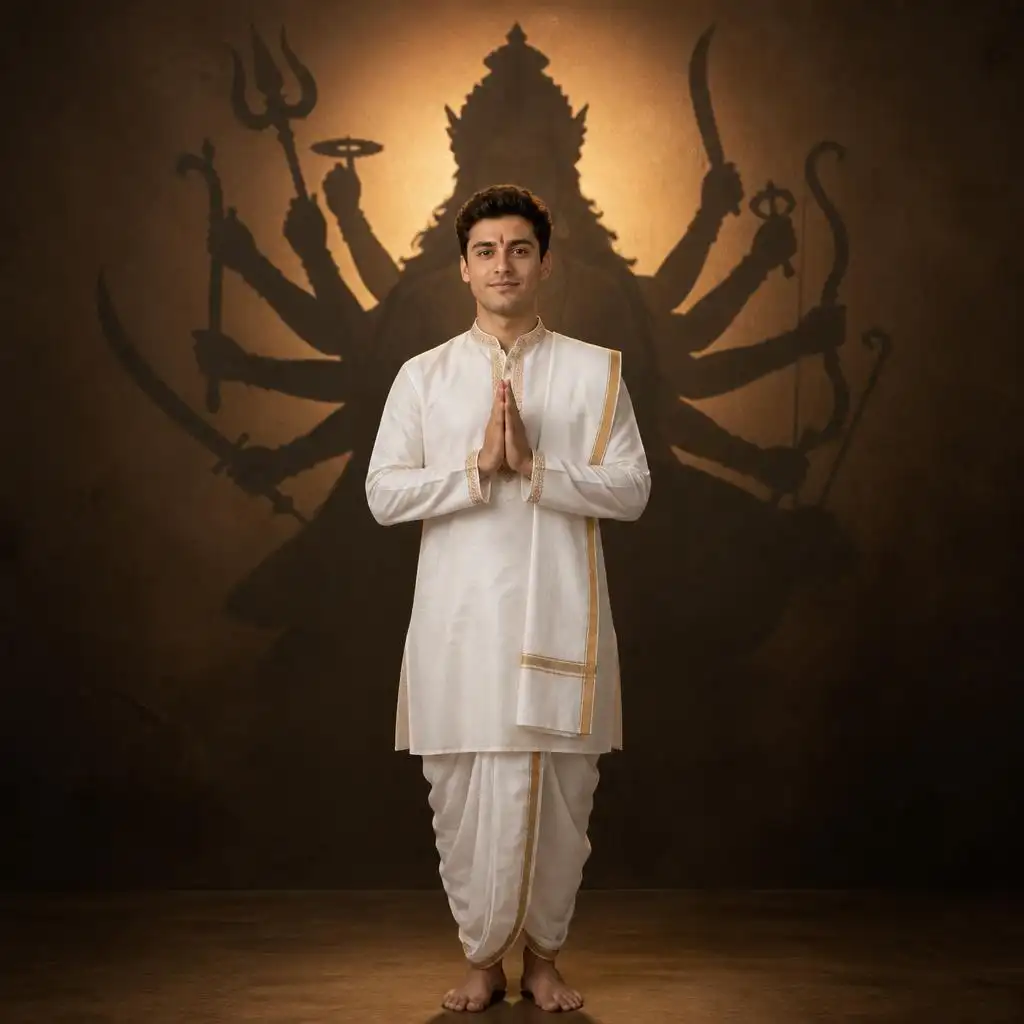
Transform the uploaded photo of the man into the same composition, pose, outfit, lighting, and devotional atmosphere as the reference image. Preserve his exact identity and make him clearly recognizable. Keep his original facial structure, skin tone, eyes, nose, lips, jawline, hairstyle, beard or moustache, age, and body proportions. Do not beautify, reshape, or replace his face.
Create a vertical full-body portrait with the man standing perfectly centered and facing the camera. His posture is straight and calm, with both hands naturally joined at chest level in a namaste pose. Give him a peaceful, serious devotional expression and add a traditional red tilak on his forehead.
Dress him in an elegant plain white traditional kurta and white dhoti, with subtle gold embroidery around the collar and cuffs. Drape a long white angavastram with a thin golden border naturally over one shoulder. Keep him barefoot.
Behind him, create a dark warm-brown wall illuminated by a single soft golden backlight. Form a large dramatic shadow silhouette of Maa Durga directly behind him, with multiple arms holding symbolic traditional items such as a trishul, sword, chakra, bow, and other recognizable forms. The shadow should tower above and around him while remaining elegant and devotional.
Match the reference with symmetrical centered framing, full-body composition, eye-level camera, dark brown and warm-gold tones, soft spotlight, realistic floor shadow, sharp facial details, natural skin texture, and cinematic photography.
The man must look physically present in the scene, not pasted or cut out. Match ambient lighting, golden rim light, shadows, perspective, edge softness, exposure, and depth naturally. No halo, hard cutout edges, fake background separation, or mismatched lighting.
10. Dhunuchi Dance Durga Puja look
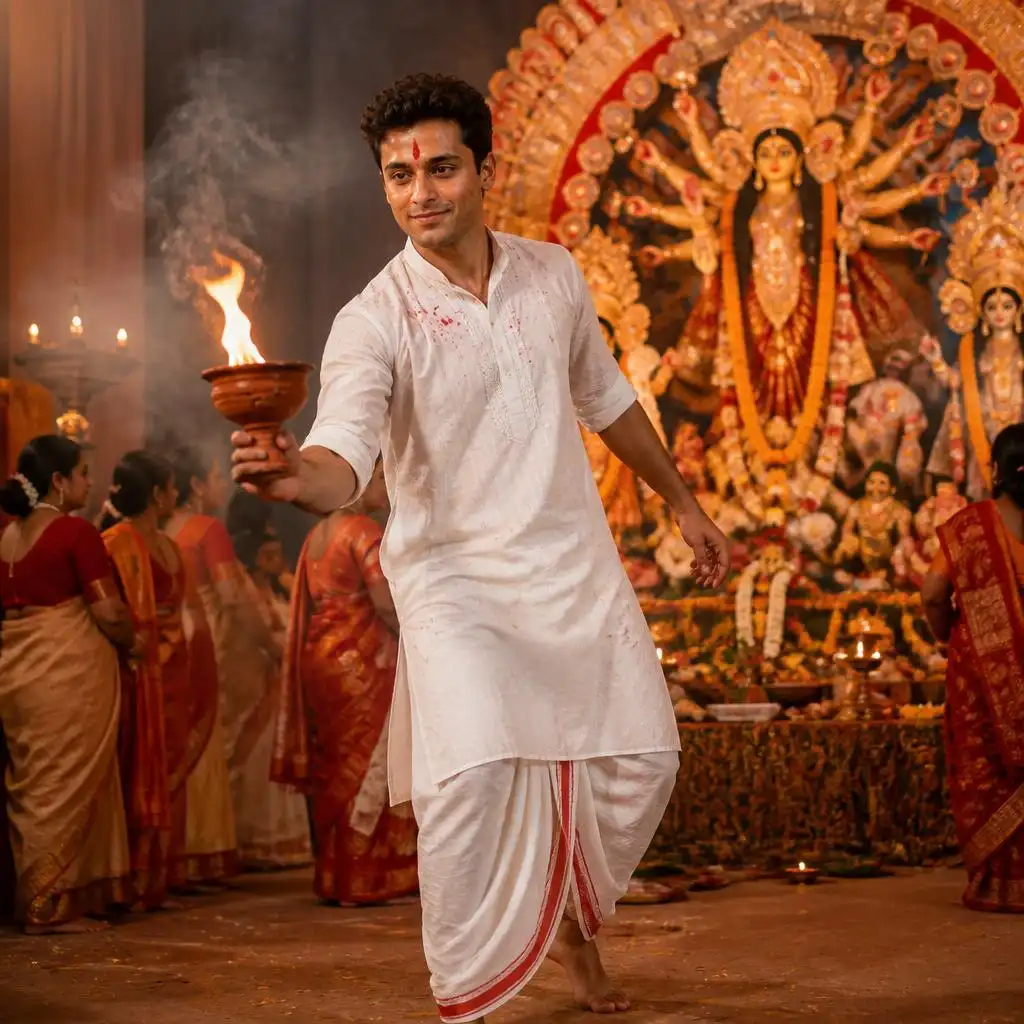
Transform the uploaded photo of the man into the same composition, pose, outfit, and festive Durga Puja atmosphere as the reference image. Preserve his exact identity and keep him clearly recognizable. Maintain his original facial structure, skin tone, hairstyle, beard or moustache, eyes, nose, lips, jawline, age, and body proportions. Do not beautify, reshape, or replace his face.
Create a vertical full-body candid portrait of him performing a traditional Dhunuchi dance during Durga Puja/Navratri. Position him slightly off-center with his body leaning naturally into the dance. His head is slightly lowered and turned toward the burning dhunuchi in his hand. Give him a focused, devotional expression.
Dress him in a simple white traditional Bengali kurta and white dhoti with bold red borders. Keep the sleeves naturally rolled. Add subtle red sindoor marks and festive colour stains on the white kurta for an authentic celebration look. He is barefoot.
Show him holding a traditional clay dhunuchi with a bright ceremonial flame and soft rising incense smoke in one extended hand. Keep the other arm naturally positioned for balance.
Behind him, recreate a grand Maa Durga idol with multiple arms, ornate crown, traditional decorations, marigold garlands, and accompanying idols. Include women in red, orange, and traditional sarees celebrating naturally in the background. Add flowers, diyas, puja decorations, warm lights, and subtle smoky atmosphere.
Use eye-level full-body framing, candid festival photography, warm cinematic lighting, realistic flame glow on his hand and clothes, natural motion, detailed skin, soft background depth, and authentic colours.
The man must look naturally photographed inside the pandal, not pasted or cut out. Match lighting, shadows, perspective, grain, edge softness, colour temperature, and depth of field. No halo, hard edges, fake blur, or artificial compositing.
11. Navratri Dhol Celebration Look
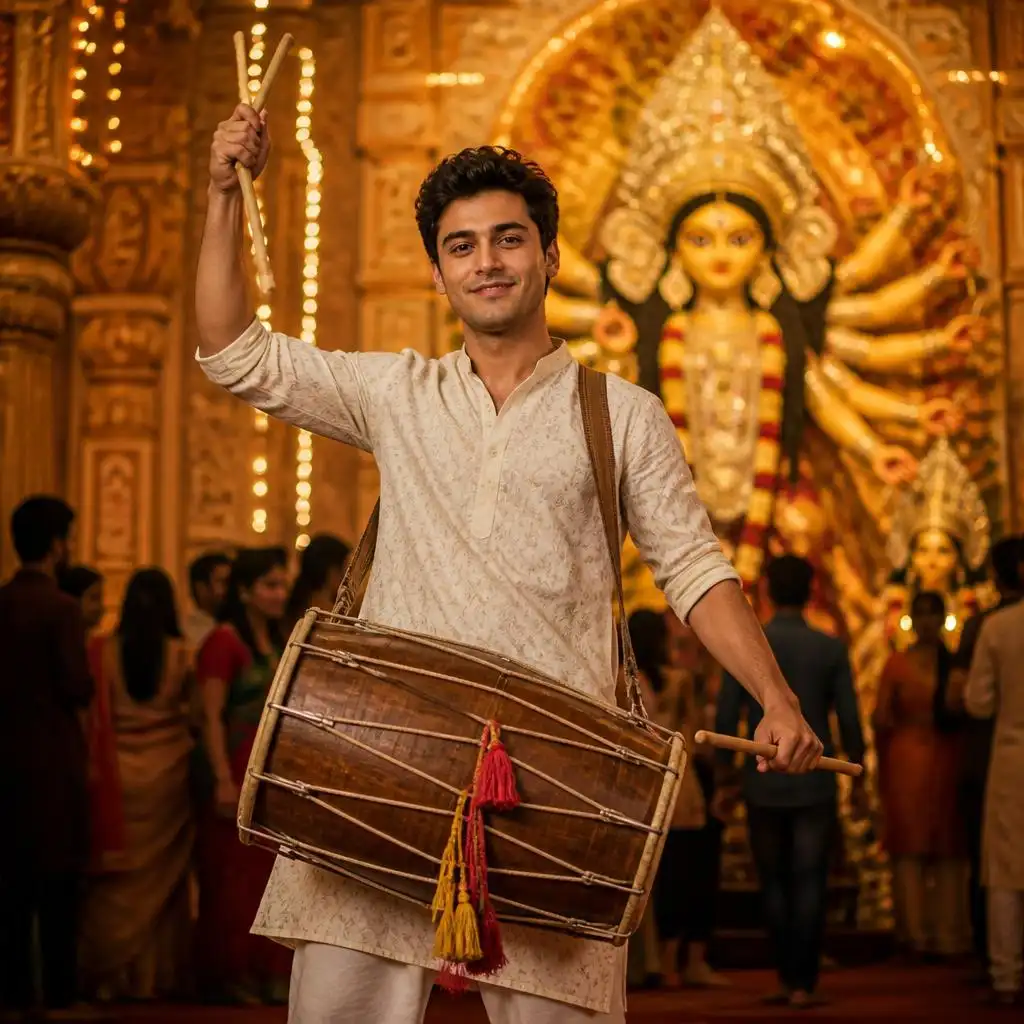
Transform the uploaded photo of the man into the same festive composition, pose, outfit style, and atmosphere as the reference image, but include only ONE main man. Preserve his exact identity and keep his face clearly recognizable. Maintain his original facial structure, skin tone, hairstyle, beard or moustache, eyes, nose, lips, jawline, age, and body proportions. Do not beautify, reshape, or replace his face.
Create a vertical full-body candid portrait of the man energetically playing a large traditional wooden dhol during a Navratri/Durga Puja celebration. Strap the dhol naturally across his torso at waist level. Show one arm raised high holding a wooden drumstick while the other hand holds another drumstick naturally near the dhol, capturing an energetic mid-performance moment. Give him a joyful, expressive festival expression.
Dress him in a light off-white traditional kurta with subtle beige floral patterns, sleeves rolled to the elbows, paired with matching traditional bottoms. Keep the clothing slightly relaxed and realistic.
Behind him, show a grand illuminated Maa Durga idol with an ornate crown, multiple arms, flower garlands, intricate golden decorations, carved temple-style pillars, and hundreds of warm fairy lights. Include a softly blurred festive crowd in the distant background, but do not include another prominent male drummer or duplicate the uploaded man.
Use warm golden lighting, eye-level photography, full-body framing, shallow depth of field, realistic movement, creamy bokeh, detailed skin, natural fabric texture, and cinematic DSLR quality.
The man must look naturally photographed inside the pandal, not pasted or cut out. Match ambient lighting, shadows, perspective, colour temperature, edge softness, grain, and depth of field. No halo, hard cutout edges, duplicate person, mismatched lighting, or artificial compositing.
Tips for creating realistic Navratri AI photos for men
- Use a clear photo: Choose a well-lit photo with your face clearly visible.
- Keep your face unchanged: Ask AI to preserve your face, skin tone, hairstyle, and age.
- Describe the outfit: Clearly mention the kurta, kediyu, dhoti, Nehru jacket, or other festive wear.
- Add Navratri details: Include dandiya sticks, mirror work, garba decorations, diyas, and festive lights.
- Keep it natural: Use realistic poses, natural lighting, and simple backgrounds for better results.
How to create your own Navratri image for men
Step 1: Upload your photo
Choose a clear photo with your face clearly visible and upload it to the Image to Image tool.
Step 2: Add your prompt
Describe the Navratri look you want to create. You can ask for a traditional kediyu, mirror-work kurta, garba outfit, dandiya look, Navratri decorations, or any other festive style.
Step 3: Choose an AI model
Choose from Wan, Flux, GPT Image, Nano Banana, or Seedream based on the style you want.
Step 4: Generate your photo
Click on Generate. LightX will create your personalized Navratri image while retaining the aspect ratio of your uploaded photo.
Step 5: Download and share
Try another prompt or AI model if needed. Download your favorite result and share it as a Navratri DP, WhatsApp status, Instagram post, or festive profile picture.
Tip: Use Change with AI to refine specific details, such as your kurta, kediyu, accessories, pose, colours, or garba background, with a follow-up prompt without regenerating the entire image.
Related blog: Bal Ganesha Photo Editing Prompts
Navratri Outfit Ideas For Men
Choosing the right Navratri outfit is all about mixing festive style with comfort. Here are some simple Navratri outfit ideas for men for garba and dandiya nights:
- Traditional kediyu: Wear a colorful kediyu with chorno, mirror work, and mojari for a traditional Gujarati look.
- Kurta with Nehru jacket: Pair a simple kurta pyjama with an embroidered or printed Nehru jacket.
- Dhoti kurta: Choose a comfortable kurta with dhoti pants for a traditional yet stylish garba outfit.
- Short kurta with jeans: Pair a colorful or block-print short kurta with jeans for a simple modern look.
- Indo-western look: Try an asymmetrical kurta with trousers, a waistcoat, and jutti for a modern festive style.
- Bandhgala look: Wear a bandhgala or Jodhpuri suit with subtle embroidery for a more elegant Navratri event.
Navratri 2026 Colours for Men’s Outfits
The nine Navratri colours are a simple way to plan a different festive look for every day. Men can use each colour in a kurta, kediyu, Nehru jacket, stole, safa, or accessories. You can also use these combinations when creating your Navratri AI photos.
Day 1 – Orange: Try an orange kurta with an ivory dhoti or white pyjama for a bright festive look.
Day 2 – White: Wear a white kurta pyjama with a colorful mirror-work Nehru jacket or stole.
Day 3 – Red: Choose a red kediyu or kurta with white chorno and traditional mojari.
Day 4 – Royal blue: Pair a royal blue kurta with beige dhoti pants or an embroidered waistcoat.
Day 5 – Yellow: Try a yellow short kurta with white pyjama or jeans for a simple garba look.
Day 6 – Green: Wear a green kurta with an ivory dhoti, brown kolhapuri chappal, and a printed stole.
Day 7 – Grey: Choose a grey kurta or bandhgala with subtle embroidery for a modern Navratri look.
Day 8 – Purple: Try a purple kurta with white churidar and an embroidered Nehru jacket.
Day 9 – Peacock green: Wear a peacock-green kurta or kediyu with mirror work for the final Navratri celebrations.
These Navratri colours 2026 outfit ideas for men can also be added directly to AI prompts to create a different look for each day.
Create your own Navratri look
Your Navratri photo does not have to look like everyone else’s.
You can keep your real face and experiment with different Navratri ethnic wear for men, backgrounds, poses, colors, and photography styles.
Try a traditional Gujarati kediyu, a mirror-work kurta for garba night, a simple short kurta with jeans, or a stylish Indo-western outfit.
Choose one of these Navratri image prompts for men, upload your photo, customize the details you like, and create a Navratri image that feels personal to you.
FAQs
What should men wear for Navratri?
Men can wear a kediyu, kurta pyjama, dhoti kurta, short kurta, Nehru jacket, or Indo-western outfit. For garba, choose an outfit that is comfortable enough for dancing.
What is a kediyu and how to style it?
A kediyu is a traditional Gujarati upper garment often worn during garba and other folk celebrations. For a festive Navratri look, pair it with chorno or dhoti-style bottoms, mojari, and a traditional pagdi or safa.
How to style a kurta for garba night?
Choose a comfortable kurta and pair it with churidar, dhoti pants, or jeans. Mirror work, bandhani prints, embroidery, a Nehru jacket, or a colorful stole can make a simple kurta more festive.
What is a good Navratri outfit for men under ₹2000?
A simple cotton kurta with jeans or pyjama pants can be a practical budget option. You can add a colorful stole, waistcoat, or traditional footwear instead of buying a completely new outfit.
What is the best colour combination for a men’s Navratri kurta?
Popular festive combinations include white and red, navy and gold, mustard and blue, maroon and cream, and green and ivory. Choose colors that also suit the Navratri day or the type of celebration you are attending.
Can I create a Navratri AI photo using my own photo?
Yes. Upload a clear photo and use an image-to-image prompt. Tell the AI to preserve your original face and then describe the Navratri outfit, pose, decorations, background, and lighting you want.
Get on WhatsApp
New image & Video workflow everyday